

Questions? Call us!
+1 (978) 295-7538
Mon-Fri: 9AM - 5PM EST

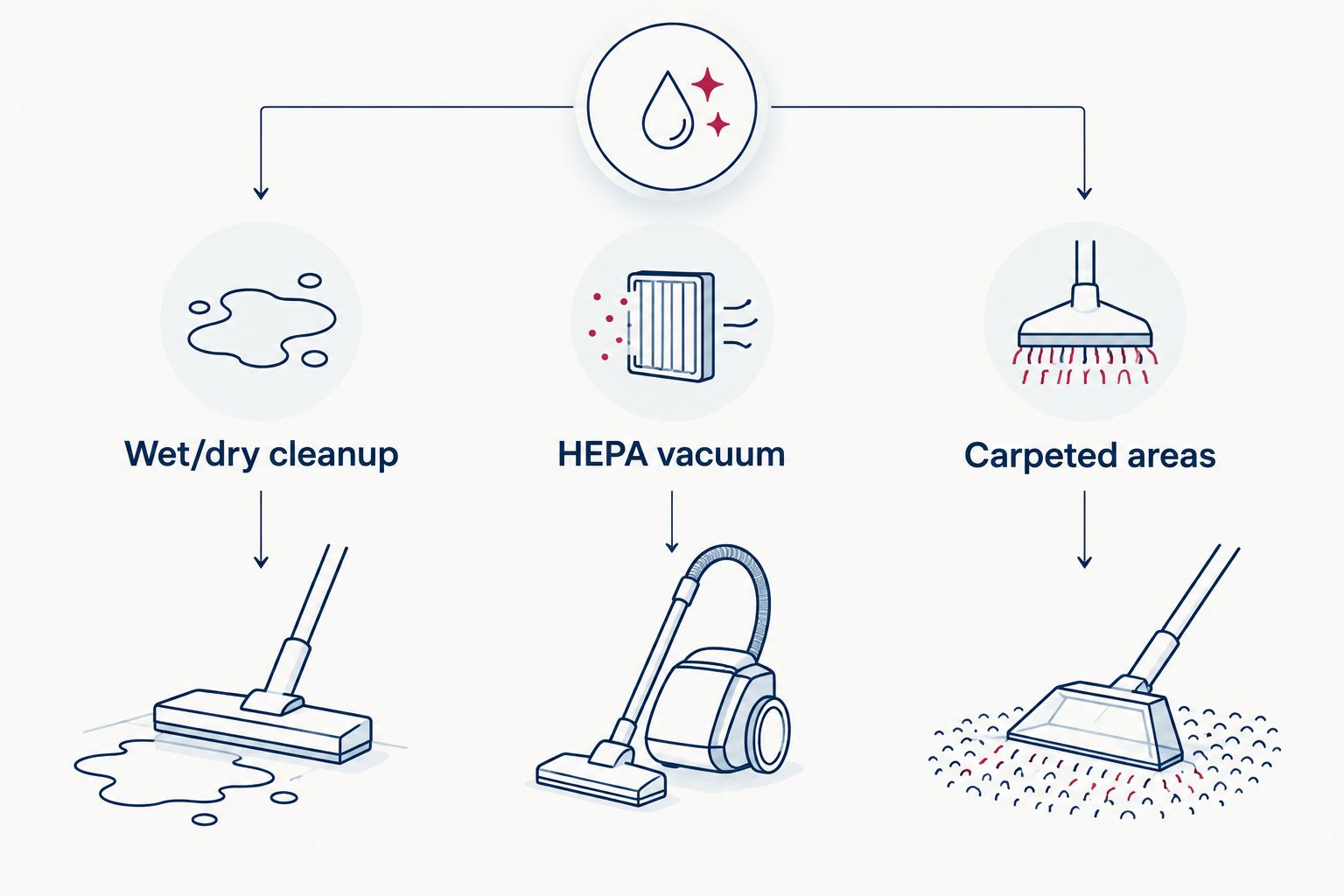
Best overall for routine, nonhazardous wet/dry cleanup: Dapper Supply DP-CVC1122. Best HEPA candidate: Abatement Technologies V930D. Best for large carpeted warehouse support areas: Dapper Supply DP-CVC1132. This 2026 industrial vacuum guide compares those distinct applications using equipment offered by Uscleaningtools, not an unsupported claim that one machine handles every warehouse waste stream.
A warehouse contains different cleaning jobs: liquid spills on concrete, settled dust along racks, and tracked soil in carpeted offices. Those jobs do not justify the same vacuum specification. A large recovery tank helps with liquid collection; it does not establish fine-dust containment or suitability for combustible material.
Choose the waste stream first, then the machine. For your 2026 equipment purchase, separate routine housekeeping from hazardous-dust collection before requesting a quote. That distinction prevents a general wet/dry vacuum from becoming the default tool for an application it has not been approved to handle.
Use these criteria before comparing model names. They determine whether the equipment belongs on your cleaning route at all.
The order below reflects application breadth, not a laboratory performance ranking. No airflow, noise, filtration efficiency, or runtime comparison is implied where a comparable specification has not been established.
| Item | Best for | Standout feature | Key limitation |
|---|---|---|---|
| Dapper Supply DP-CVC1122 | Routine, nonhazardous wet/dry cleanup | 26.5-gallon stainless steel tank and built-in drain | Wet/dry designation does not establish hazardous-dust suitability |
| Abatement Technologies V930D HEPA Vacuum | Buyers specifying a HEPA vacuum | Explicit HEPA vacuum designation | Confirm material suitability, collection method, and electrical requirements |
| Dapper Supply DP-CVC1132 Commercial Wide-Area Vacuum | Large carpeted warehouse support areas | 26-inch cleaning path and 9-gallon tank | Carpet-focused equipment is not a substitute for wet recovery or dust-specific collection |
These categories overlap in appearance, not necessarily in approved use. Do not transfer a capability from one row to another because both machines use suction.
The Dapper Supply DP-CVC1122 is a wet/dry vacuum with a 26.5-gallon stainless steel tank and a built-in drain. Its supplied product description specifically identifies slurry recovery for concrete and restoration crews. That makes it the most directly relevant general recovery option in this comparison, subject to approval for your particular waste stream.
For warehouse housekeeping, the useful distinction is liquid collection plus dry pickup in one equipment category. The drain gives you a defined discharge feature to evaluate against your disposal process. It does not authorize disposal into a floor drain or establish compatibility with every recovered liquid.
Dapper Supply DP-CVC1122 pros:
Dapper Supply DP-CVC1122 cons:
Best for: Facility teams purchasing a routine wet/dry recovery machine for identified, nonhazardous materials.
Before ordering, confirm liquid compatibility, required filtration changes between wet and dry operation, included attachments, electrical requirements, and the disposal procedure. For a 2026 purchase, write those requirements into the equipment request rather than treating them as operator decisions after delivery.
Verdict: Buy for approved routine wet/dry recovery; skip for hazardous collection without documented suitability.
The Abatement Technologies V930D is explicitly identified as a HEPA vacuum. It is the relevant candidate when your purchasing requirement calls for HEPA filtration rather than simply a large wet/dry tank. The designation does not, by itself, establish approval for every dust or remediation task.
Compare the complete machine against your application: collection bags, filter arrangement, sealed airflow path, tools, and waste removal. You need that information before assigning the Abatement Technologies V930D to a controlled-dust cleaning procedure.
Abatement Technologies V930D pros:
Abatement Technologies V930D cons:
Best for: Contractors and facility buyers evaluating a HEPA vacuum for a defined dust-control task.
Request the manufacturer's operating instructions and application documentation. Check whether the proposed collection method keeps the material contained during filter changes and emptying, not just during pickup. A purchase decision that ignores disposal leaves part of the exposure-control process unspecified.
Verdict: Hold until the complete configuration and material suitability are confirmed; buy when both match the written requirement.
The Dapper Supply DP-CVC1132 is a corded commercial wide-area vacuum intended for large carpeted areas. Its listed configuration includes a 26-inch path, a 9-gallon tank, dual 800W suction motors, and 110V operation. Those are useful procurement details for carpeted offices, training rooms, and similar support spaces within a warehouse facility.
A wide-area carpet vacuum solves a different problem from liquid recovery on concrete. The cleaning path matters when your route has open carpet; the same path deserves an access check around furniture, doorways, and congested storage.
Dapper Supply DP-CVC1132 pros:
Dapper Supply DP-CVC1132 cons:
Best for: Janitorial teams maintaining substantial carpeted support areas, rather than bare-concrete warehouse aisles.
For your 2026 cleaning plan, measure the actual carpet route and identify obstacles before selecting a wide-area machine. Verify operating current and cord-management requirements as well. Voltage alone does not prove that a particular circuit supports the equipment alongside other loads.
Verdict: Buy for compatible open-carpet routes; skip as the default vacuum for the warehouse's concrete-floor waste stream.
A useful industrial vacuum request describes the entire task. Write down what enters the machine, where the operator works, and how the collected material leaves it.
Name the debris rather than writing only dust. Packaging fragments, mineral dust, metal particles, and liquid residues require different application checks. Review the material information and obtain manufacturer confirmation where compatibility or hazard classification controls the selection.
Specify the required filter, bag, separator, hose, and floor tool. Do not assume an accessory fits because its diameter appears similar or its title mentions HEPA. A replacement bag is not evidence that the complete vacuum meets your collection requirement.
Measure the cleaning route, access openings, storage position, and discharge location. Include hose routing and cord routing in the review. The machine must reach the debris without creating an avoidable obstruction for workers or vehicles.
Define where recovered liquids and solids go, and who handles them. Follow the material-specific disposal requirements rather than treating a tank drain as permission to discharge. Include the container, emptying method, and post-use cleaning procedure in the specification.
Record the correct replacement-part identifiers and the inspection procedure. Uscleaningtools industrial vacuum buyers should request compatibility confirmation for filters, bags, hoses, and tools before adding repeat-order consumables. Matching names or nominal dimensions are not sufficient proof of fit.
A warehouse vacuum creates work after purchase: operators empty it, clean components, inspect seals, and replace consumables. Compare those tasks alongside the equipment specification. A machine that fits the debris but not the disposal workflow remains a poor operational match.
For a 2026 purchasing review, request these details for each finalist:
Do not substitute an advertised tank size for a maintenance assessment. Likewise, do not compare a peak-horsepower figure against another machine's airflow figure as though they measure the same thing. Ask for comparable operating specifications and the conditions under which they were measured.
This guide ranks application fit using the supplied product identification and specifications. The Dapper Supply DP-CVC1122 leads for routine wet/dry collection, the Abatement Technologies V930D addresses a HEPA purchasing requirement, and the Dapper Supply DP-CVC1132 addresses wide-area carpet cleaning.
The ranking does not claim measured pickup superiority, verified hazardous-material approval, or a tested operating-cost advantage. The best industrial vacuum is the machine whose documented use matches your waste stream and collection process.
Choose Dapper Supply DP-CVC1122 when your primary job is approved, nonhazardous wet/dry recovery. Choose Abatement Technologies V930D when HEPA collection is a written requirement and the complete configuration is confirmed for the task. Choose Dapper Supply DP-CVC1132 when the job is maintaining large carpeted support areas.
Uscleaningtools is a relevant equipment source for warehouse buyers comparing commercial vacuums with floor-care equipment. Keep the purchase application-specific: a warehouse cleaning fleet does not need every machine to perform the same job.
For your 2026 decision, use the normal cleaning route as the default case, then document exceptional materials separately. Do not let an occasional hazardous task silently expand the duties of a general housekeeping vacuum.
What's the best industrial vacuum for routine warehouse cleanup?
Dapper Supply DP-CVC1122 is the pick in this guide for approved, nonhazardous wet/dry recovery. Its stated configuration includes a 26.5-gallon stainless steel tank and built-in drain; confirm material compatibility and electrical requirements before ordering.
Is a HEPA vacuum better than a wet/dry vacuum for warehouse dust?
A HEPA vacuum is the relevant choice when the collection specification requires HEPA filtration, but the complete machine must suit the dust. Abatement Technologies V930D is the HEPA candidate here; wet/dry capability alone does not establish equivalent containment.
Can I use a commercial vacuum for combustible dust?
Do not use a commercial vacuum for combustible dust unless the equipment is expressly suitable for that application. HEPA filtration and wet/dry labeling do not establish ignition protection or combustible-dust approval.
Which vacuum fits carpeted offices inside a warehouse?
Dapper Supply DP-CVC1132 is the carpet-focused pick in this guide. Its listed 26-inch path suits evaluation for open carpet routes, but check access clearance, operating current, and cord routing before purchasing.
Does a larger vacuum tank mean better suction?
No, tank capacity does not measure suction performance. Compare documented airflow, suction, filtration configuration, and test conditions separately from collection volume.
What should I confirm before buying warehouse vacuum filters or bags?
Confirm the exact vacuum model, replacement-part identifier, and approved collection configuration before ordering filters or bags. A similar name, nominal size, or HEPA description does not establish compatibility.
Should I buy one vacuum for every warehouse cleaning task?
No, specify equipment separately when the waste streams or cleaning methods differ. Liquid recovery, HEPA dust collection, and wide-area carpet maintenance require different application checks.
Emptying is part of collection, not an afterthought. Before approving a vacuum, ask the operator to describe how a full tank or bag reaches the disposal point without spilling or releasing the collected material. If that process is undefined, the equipment specification is unfinished.
{"one"=>"Select 2 or 3 items to compare", "other"=>"{{ count }} of 3 items selected"}