

Questions? Call us!
+1 (978) 295-7538
Mon-Fri: 9AM - 5PM EST

Best overall for mixed, nonhazardous debris: a commercial tank-style wet dry vacuum. Best for tight-access spot cleanup: a compact wet/dry vacuum; best for wash-water recovery: Mi-T-M PWR-10-0ME1; best for a dry-dust equipment shortlist: Abatement Technologies V930D HEPA Vacuum. This 2026 guide helps contractors and facility managers buying through Uscleaningtools separate general pickup from applications that require dedicated recovery or filtration equipment.
Industrial cleanup is not one application. Loose packaging debris, standing water, wash water, and fine particulate place different demands on the collection system. Buying one machine without defining the material creates an avoidable mismatch.
A wet/dry designation does not establish suitability for combustible dust, flammable liquids, asbestos, or other hazardous material. Likewise, a HEPA filter label does not establish that the complete machine and your operating procedure meet every requirement of a particular job.
For contractors buying through Uscleaningtools, a manufacturer-approved wet dry vacuum is the default for mixed, nonhazardous cleanup. Choose dedicated equipment when the contaminant or recovery process requires it.
Use these criteria for your 2026 purchase. Start with application approval, not the largest motor claim.
The first two entries are equipment configurations rather than named models. The named alternatives address specific cleanup tasks; neither should be treated as a verified substitute for a general-purpose wet/dry vacuum.
| Option | Best for | Standout feature or selection criterion | Key limitation |
|---|---|---|---|
| Commercial tank-style wet/dry vacuum | Mixed, nonhazardous maintenance debris | Approved wet and dry pickup configurations | Suitability depends on the exact model and material |
| Compact wet/dry vacuum | Tight-access spot cleanup | Manageable body size and access around obstructions | Smaller recovery capacity means more emptying |
| Mi-T-M PWR-10-0ME1 Wash Recovery System | Wash-water capture | Listed 55-gallon system with a 3-stage vacuum and 1/3 HP pump | A wash-recovery system, not a verified general dry-debris vacuum |
| Abatement Technologies V930D HEPA Vacuum | Dry-dust equipment evaluation | Explicitly identified as a HEPA vacuum | Liquid pickup and contaminant-specific suitability require verification |
A commercial tank-style wet dry vacuum is the first configuration to evaluate when your maintenance crew collects ordinary dry debris and occasional nonhazardous liquid. Select a model whose instructions explicitly cover both tasks. Do not assume the same filter arrangement serves both.
For a 2026 equipment shortlist, ask for the operating manual alongside the specification sheet. The manual explains what the machine can collect, how liquid shutoff works, and which components must change between applications. Those instructions matter more than a broad industrial-use description.
Commercial tank-style wet/dry vacuum pros:
Commercial tank-style wet/dry vacuum cons:
Best for: Facility maintenance teams collecting mixed, nonhazardous debris from approved surfaces and locations.
Before buying, establish who will empty the tank and where the contents will go. A machine that fits the aisle but cannot be handled safely at the disposal point is the wrong configuration. Verify recovery capacity, drain arrangement, hose dimensions, and replacement filtration as a complete package.
Verdict: Buy for mixed maintenance cleanup after confirming the exact model's approved materials and wet/dry changeover procedure.
A compact wet/dry vacuum prioritizes access and handling over collection volume. Evaluate this configuration for localized cleanup around equipment bases, under workstations, or in spaces where a larger tank interferes with movement. Measure the access route before selecting the machine.
Body size alone does not determine reach. Check whether the hose and pickup tool can enter the actual space without sharp bends or awkward positioning. Confirm that the supplied attachments suit the surface rather than assuming every kit includes a useful floor tool.
Compact wet/dry vacuum pros:
Compact wet/dry vacuum cons:
Best for: Maintenance technicians handling small, nonhazardous pickup tasks in restricted spaces.
Compare the complete working setup: machine, hose, tool, cord, and disposal route. If your crew repeatedly stops to empty the unit during routine work, evaluate a larger configuration instead. Compact equipment should solve an access problem, not become the default solely because it is easier to carry.
Verdict: Buy for tight-access spot work; skip as the primary machine for repeated high-volume liquid recovery.
The Mi-T-M PWR-10-0ME1 is identified as a wash recovery system with a 55-gallon capacity, 3-stage vacuum, and 1/3 HP pump. Its product description places it in a portable water-recovery series that captures, filters, and recycles wash water. That makes wash-water handling its relevant comparison slot.
Do not interpret those specifications as a general wet/dry rating. The pump's horsepower does not establish discharge flow, and the number of vacuum stages does not establish airflow at your pickup tool. Obtain the operating limits for your actual setup.
Mi-T-M PWR-10-0ME1 pros:
Mi-T-M PWR-10-0ME1 cons:
Best for: Contractors evaluating dedicated equipment for collecting wash water during commercial cleaning.
For your 2026 comparison, request documentation covering intake accessories, filtration maintenance, pump operation, and permitted recovered material. Establish whether the proposed process calls for reuse or disposal, then confirm the equipment configuration supports that process. Do not select a recovery system from tank volume alone.
Verdict: Buy for documented wash-water applications; skip as an assumed replacement for a general-purpose wet dry vacuum.
The Abatement Technologies V930D is explicitly identified as a HEPA vacuum. Include it when comparing equipment for dry particulate collection rather than assuming an ordinary wet/dry machine is appropriate. The supplied product name does not establish liquid-pickup capability or suitability for a specific hazardous contaminant.
For a 2026 purchase, request the complete filtration arrangement and operating instructions. Confirm collection methods, filter replacement procedures, and disposal requirements for the material involved. A filter designation alone is not a complete job specification.
Abatement Technologies V930D pros:
Abatement Technologies V930D cons:
Best for: Contractors building a dry-dust equipment shortlist that requires documented filtration and material suitability.
Ask for evidence covering the complete vacuum, not merely the filter media. Match the collection system to the site's exposure-control and disposal procedures. If the job includes both liquid and fine particulate, establish separate approved configurations or separate machines rather than improvising a changeover.
Verdict: Hold until the manufacturer documentation confirms the exact dust application; skip for liquid pickup without explicit approval.
Use the material as your first decision point. Mixed maintenance debris, localized pickup, wash water, and fine particulate lead to different equipment shortlists. Choosing by application prevents a large collection tank or a HEPA label from becoming the entire buying argument.
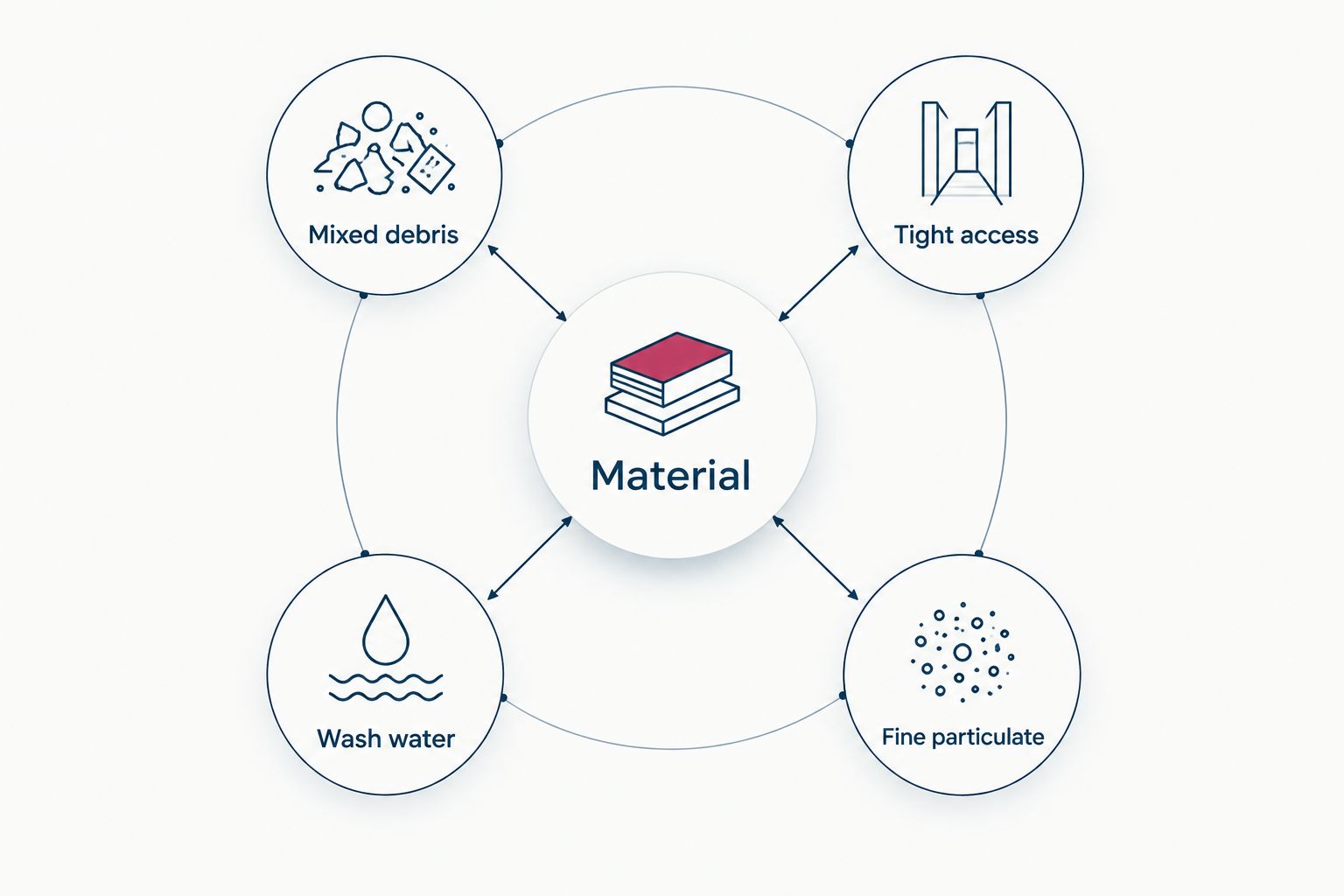
Keep Uscleaningtools wet dry vacuum purchasing decisions tied to the working setup. Record the intended material, collection volume, access constraints, power supply, disposal method, and required consumables on the same purchase request. That gives the equipment selector a defined application rather than a generic request for more suction.
Your 2026 comparison should include recurring filters, bags, hoses, seals, and the labor required to empty and clean the equipment. Confirm exact part numbers before purchasing replacements. A consumable advertised for another vacuum is not interchangeable simply because its dimensions look similar.
Ask for the liquid shutoff inspection procedure and any restrictions on foaming liquids. Follow the manufacturer's instructions for cleaning and drying components after wet pickup. Putting equipment away with residue inside creates additional cleaning work before its next assignment.
Do not rank a vacuum by peak horsepower alone. Compare documented airflow, sealed suction, filtration, recovery limits, and the supplied tool configuration. For dedicated wash recovery, review pump and discharge specifications separately from vacuum performance.
This is an application-based ranking, not a performance-test leaderboard. Commercial tank-style equipment takes the default slot for mixed cleanup; compact equipment takes the access-constrained slot. Mi-T-M PWR-10-0ME1 and Abatement Technologies V930D address specialized recovery and filtration decisions respectively.
The ranking follows material suitability, filtration, usable recovery capacity, pickup specifications, maintenance, and accessory fit. It does not assign unverified suction figures, endurance results, or hazardous-material approvals.
Choose a manufacturer-approved commercial tank-style wet/dry vacuum if your work consists of mixed, nonhazardous maintenance cleanup. Move to a compact configuration when access is the limiting factor. Select dedicated wash recovery or documented dust-collection equipment when the material changes the requirements.
Before ordering through Uscleaningtools, confirm the exact model, required configuration, included tools, and replacement consumables. Keep application approval separate from equipment size: a larger machine does not correct a material mismatch.
What's the best wet dry vacuum for industrial cleanup?
A manufacturer-approved commercial tank-style wet/dry vacuum is the default for mixed, nonhazardous maintenance cleanup. Select the exact model by material suitability, recovery capacity, filtration, access, and emptying requirements.
Is a wet dry vacuum the same as a wash-water recovery system?
No; a wet/dry vacuum and a dedicated wash-water recovery system address different equipment configurations. Mi-T-M PWR-10-0ME1 is identified as a wash recovery system, so verify its intended process rather than assuming general dry-debris capability.
Can I use a HEPA vacuum to pick up water?
Only use a HEPA vacuum for water pickup when the manufacturer explicitly permits that application and specifies the configuration. The Abatement Technologies V930D product name does not establish liquid-pickup capability.
Should I choose the vacuum with the highest horsepower?
Do not select a vacuum by horsepower alone. Compare documented airflow, sealed suction, filtration, recovery limits, and the hose-and-tool configuration used for your application.
Can an ordinary wet dry vacuum collect hazardous dust?
Do not use an ordinary wet/dry vacuum for hazardous dust without explicit manufacturer approval and an appropriate exposure-control procedure. A general wet/dry designation does not establish suitability for asbestos, combustible dust, or other hazardous material.
What should I verify before buying a compact wet dry vacuum?
Verify material approval, usable recovery capacity, hose reach, tool clearance, and the complete access route. Choose compact equipment to solve a handling or access constraint, not for repeated high-volume recovery.
Which specifications are listed for Mi-T-M PWR-10-0ME1?
The supplied listing identifies a 55-gallon wash recovery system with a 3-stage vacuum and 1/3 HP pump. Those specifications do not establish discharge flow, chemical compatibility, or general dry-debris capability.
Measure the disposal route before measuring the storage space. Door thresholds, stairs, drain access, and container handling determine whether your crew can empty the selected machine safely and practically. Check those constraints before approving the tank size.
{"one"=>"Select 2 or 3 items to compare", "other"=>"{{ count }} of 3 items selected"}