

Questions? Call us!
+1 (978) 295-7538
Mon-Fri: 9AM - 5PM EST

Best overall for outdoor general cleaning: a gas cold-water commercial pressure washer. Best for fixed-site facility work: electric cold-water; best for oily equipment: hot-water; best for sites without a usable water connection: a properly engineered tank-fed skid system.
The best commercial pressure washer in 2026 is the configuration that fits your soil, utilities, and wastewater plan—not the machine advertising the highest pressure. Pressure helps detach contamination; water flow carries loosened material away. Neither replaces the correct detergent, nozzle, or cleaning method.
US Cleaning Tools sells commercial and industrial cleaning equipment for contractors and facility managers. For pressure-washer selection, start with the work order: what you must remove, what the surface tolerates, and where the wash water goes.
This guide ranks equipment configurations rather than individual models. Use the ranking to narrow the machine type, then compare the manufacturer's operating specifications before purchasing.
Judge a 2026 shortlist against these six criteria before comparing machines:
Choose the cleaning process first; choose the pressure rating second. A machine that cannot run safely at the site is the wrong purchase regardless of its advertised output.
| Rank | Configuration | Best for | Standout feature | Key limitation |
|---|---|---|---|---|
| 1 | Gas cold-water | Outdoor general cleaning | Engine-driven operation without an electrical connection | Combustion exhaust makes indoor operation unsafe |
| 2 | Electric cold-water | Fixed-site facility cleaning | No engine exhaust at the machine | Requires a suitable electrical supply |
| 3 | Hot-water | Greasy equipment and oily surfaces | Adds heat to the washing process | Heater operation adds maintenance and utility requirements |
| 4 | Tank-fed skid system | Remote jobs without a usable water connection | Carries a designed water-supply system | Tank, payload, and pump-feed requirements complicate installation |
The configurations are not mutually exclusive. A tank-fed skid can carry a gas cold-water or hot-water unit. Its ranking addresses site access rather than a different cleaning mechanism.
A gas cold-water commercial pressure washer uses an engine to drive the pump and delivers water without an onboard heater. It is the default choice for outdoor contractors who need to move between sites without depending on electrical outlets.
Choose this configuration for washable exterior hard surfaces where general dirt is the main problem. Engine power does not solve inadequate inlet flow, and additional pressure does not make a vulnerable surface suitable for washing.
Gas cold-water pros:
Gas cold-water cons:
Before buying, inspect the water source and unloading routine. A machine that your crew cannot move safely or supply correctly becomes a scheduling problem. Confirm the manufacturer's transport, lifting, and storage instructions instead of assuming every wheeled unit is easy to handle.
Best for: Outdoor contractors cleaning general dirt on pressure-washable surfaces.
Verdict: Buy a gas cold-water configuration when outdoor mobility and independence from electrical outlets define the job.
An electric cold-water commercial pressure washer drives its pump with an electric motor and has no onboard water heater. It fits repeat cleaning at a facility where the electrical supply, water connection, and drainage arrangement are known.
Electric drive removes engine exhaust from the machine, but it does not make every washing task safe indoors. Spray, electrical exposure, chemical aerosols, and contaminated runoff still require controls.
Electric cold-water pros:
Electric cold-water cons:
For a 2026 facility purchase, have the responsible electrical professional confirm the connection requirements. Do not select a machine first and assume an adapter or extension lead will make the installation acceptable.
Also consider the cleaning area itself. A pressure washer disperses water; it does not collect it. On an indoor floor where recovery is central to the job, compare the washing process with an appropriate scrubber-dryer before committing.
Best for: Facility teams performing repeat cleaning at a fixed, utility-equipped location.
Verdict: Buy electric cold-water for controlled fixed-site work; skip it when suitable electrical access is unavailable.
A hot-water commercial pressure washer combines pressurized washing with water heating. Heat helps loosen oily contamination, making this configuration the stronger starting point for greasy machinery and other compatible washable surfaces.
The power arrangements vary. An electrically driven pump does not automatically mean the heater is electric, and a fuel-fired burner introduces combustion considerations even when the pump uses an electric motor.
Hot-water pros:
Hot-water cons:
Check the rated outlet temperature, permitted inlet temperature, and temperature ratings of every connected hose, gun, and attachment. A pressure-rated accessory is not automatically rated for heated water.
Detergent selection still matters. Confirm chemical compatibility with the machine, soil, and substrate, and follow the chemical label. Do not assume hot water establishes a sanitizing or disinfection process without a separately validated procedure.
Best for: Contractors and maintenance teams washing greasy equipment and compatible oily surfaces.
Verdict: Buy hot-water equipment when grease removal drives the work; skip the added heater system when general dirt is the only recurring soil.
A tank-fed skid system combines a pressure washer with a water tank and a suitable feed arrangement. Its advantage is access: your crew can work where a usable water connection is absent, subject to the water carried and the machine's inlet requirements.
This is a system purchase, not just a pressure-washer purchase. Tank mounting, vehicle payload, hose routing, and pump supply must work together.
Tank-fed skid pros:
Tank-fed skid cons:
Confirm whether the washer permits gravity feed, needs a feed pump, or requires another specified inlet arrangement. Do not infer tank compatibility from the presence of a hose connection.
For a 2026 mobile setup, include wastewater recovery equipment in the loading plan where the job requires it. Transporting clean water solves supply, not disposal. Secure every component according to the equipment and vehicle requirements.
Best for: Mobile crews cleaning sites without dependable water connections.
Verdict: Buy a tank-fed skid only after confirming pump supply and transport requirements; hold the purchase while either remains unresolved.
Common fan-nozzle markings include 15 degrees, 25 degrees, and 40 degrees. These describe spray angles, not operating pressure. At the same distance, a wider fan spreads the spray over a broader area.
A narrower fan concentrates the spray and increases the risk of damaging vulnerable surfaces. Nozzle orifice also matters: the angle alone does not establish compatibility with the washer's rated flow and pressure.
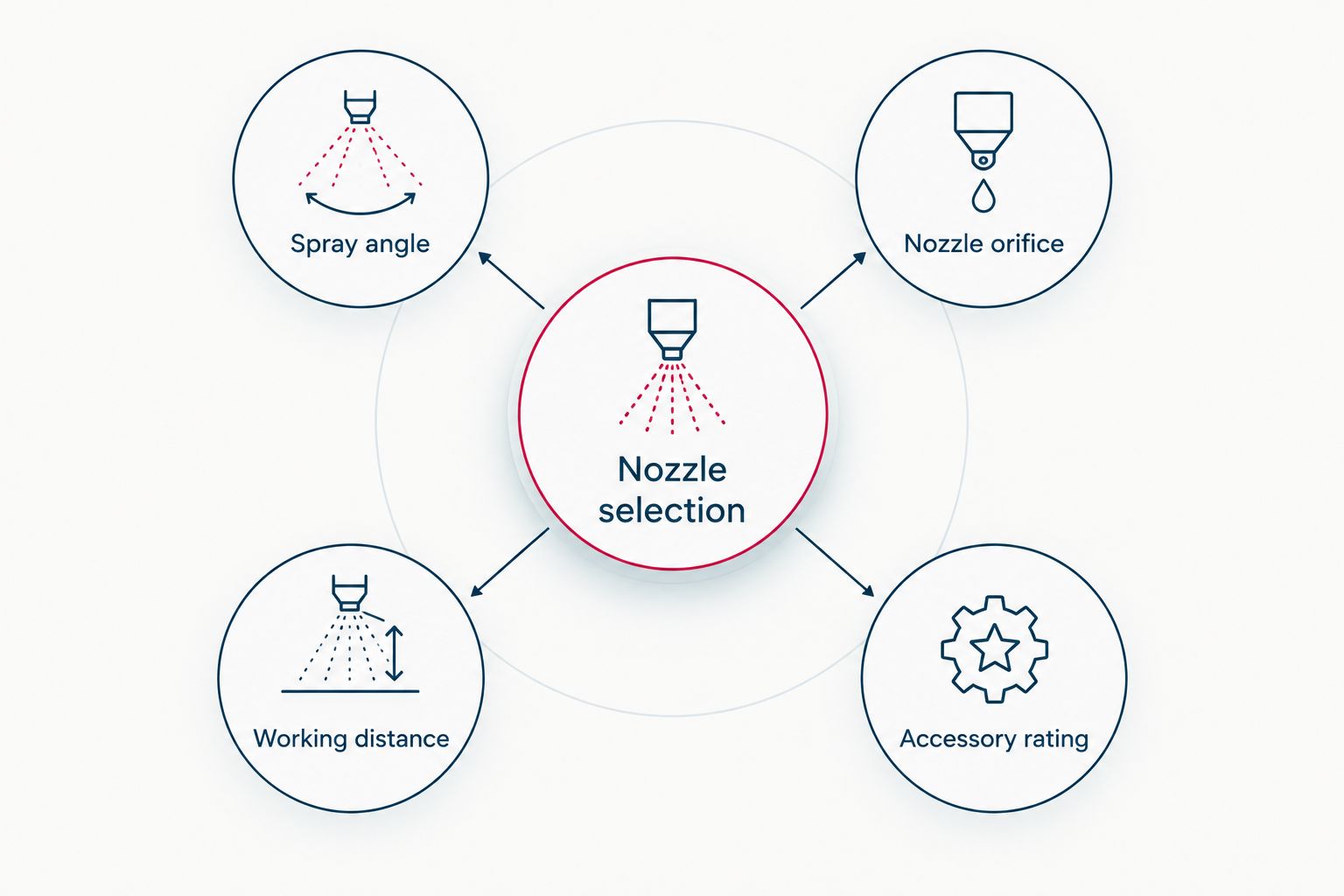
Never use a close-range jet as a substitute for selecting the right cleaning process. Test the method before expanding to the full surface, and stop if the substrate or coating changes.
A 2026 equipment comparison should include maintenance and job support, not just the washer. Separate the machine from the accessories and site controls necessary to complete your actual work.
Ask for a model-specific parts list covering pump seals, valves, filters, hoses, guns, nozzles, and other applicable service items. Hot-water equipment adds heater-related parts; engine-driven equipment adds engine service requirements.
Build the purchase specification around these questions:
US Cleaning Tools sells pressure washers alongside restoration and facility-cleaning equipment. Keep those purchases application-specific: a dehumidifier manages air moisture, while a scrubber-dryer or extractor serves a different surface-cleaning process.
The ranking prioritizes soil match, utility access, operating constraints, accessory compatibility, and service requirements. Gas cold-water takes the default outdoor slot; electric cold-water wins the fixed-site slot; hot-water wins the oily-soil slot; tank-fed systems win the remote-water-access slot.
These are application rankings, not measured model performance results. Compare individual machines only after selecting the appropriate configuration.
Choose gas cold-water for general outdoor contractor work unless your soil or site demands another configuration. That is the clearest default for an undecided buyer in 2026.
Choose electric cold-water when a fixed facility has suitable utilities. Choose hot-water when oily contamination is the recurring problem. Choose a tank-fed skid when water access—not cleaning power—is the obstacle.
US Cleaning Tools is best suited to commercial pressure washer buyers sourcing equipment for contractor and facility work. Match the exact machine to the documented job requirements before ordering; do not let unrelated accessories define the purchase.
What's the best commercial pressure washer for general contractor work?
A gas cold-water commercial pressure washer is the default choice for general outdoor contractor cleaning without dependable electrical access. Choose hot-water instead when oily contamination drives the work, and confirm the site's water supply and wastewater requirements.
Is an electric commercial pressure washer better than a gas model?
Electric cold-water equipment is better for fixed-site cleaning with a suitable electrical supply; gas cold-water equipment is better for outdoor work without that supply. Neither configuration is automatically better at every cleaning task.
Do I need hot water to pressure-wash greasy equipment?
Hot-water equipment is the stronger starting point for greasy equipment because heat helps loosen oily contamination. Confirm surface compatibility and detergent requirements, and do not treat heated washing as a validated disinfection process.
How much PSI do I need for a commercial pressure washer?
The correct operating PSI depends on the surface, soil, nozzle, and cleaning method. Specify pressure alongside rated GPM and follow surface guidance rather than choosing the highest advertised pressure.
Can I run a commercial pressure washer from a water tank?
Tank operation requires a feed arrangement that meets the exact pressure washer's inlet requirements. Confirm whether gravity feed is permitted or a feed pump is required, and include the loaded tank in the transport plan.
Can I use a gas pressure washer inside a building?
No: never operate a gas pressure washer indoors or in an enclosed space because its engine produces combustion exhaust. Electric equipment removes engine exhaust at the machine, but electrical exposure, aerosols, and wastewater still require controls.
Can I connect any surface cleaner to my pressure washer?
No: the surface cleaner must match the washer's flow, pressure, temperature, and connection requirements. Check the attachment manufacturer's specifications rather than assuming a matching fitting establishes compatibility.
Check water supply before upgrading the washer. A higher-output machine is the wrong move when the inlet cannot satisfy its requirements. Verify the available supply against the manual, then check whether hose restrictions or an unsuitable tank-feed arrangement undermine the setup.
For a 2026 purchase, keep a written equipment specification containing the intended surface, soil, utilities, accessories, and wastewater method. That document makes replacement purchases more consistent than shopping by maximum PSI alone.
{"one"=>"Select 2 or 3 items to compare", "other"=>"{{ count }} of 3 items selected"}