

Questions? Call us!
+1 (978) 295-7538
Mon-Fri: 9AM - 5PM EST

Ships from US manufacturer with factory warranty
Tell us your quantity, delivery ZIP code and required date. For help choosing equipment, include your application.
Email a quote request Call (978) 295-7538Need help choosing? Talk to an expert
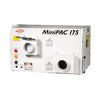
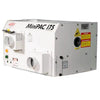
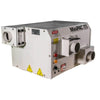
+1 (978) 295-7538The Bry-Air MiniPAC MP-175 is a 175 CFM desiccant dehumidifier for low-humidity control below the operating limits of refrigerant and LGR equipment — removes 5.8 lbs of moisture per hour at 70°F and continues operating below freezing where refrigerant compressors fail. 208–240V single-phase. Specified for cold storage staging, pharmaceutical processing, laboratories, and post-flood structural drying in cold climates.
The Bry-Air MiniPAC MP-175 is a 175 CFM desiccant dehumidifier built for environments where refrigerant or LGR equipment fails to deliver: cold storage staging areas, pharmaceutical processing rooms, laboratories holding relative humidity below 30% RH, and any space where continuous moisture removal at low ambient temperatures is required. At 5.8 lbs/hr moisture removal and 158 lbs, the MP-175 bridges the gap between the entry-level MP-100 and larger three-phase desiccant units — providing meaningful capacity uplift while remaining on single-phase 208–240V power that most facilities already have available.
The MP-175 uses a rotating desiccant wheel rather than a compressor and refrigerant circuit. Process air (175 CFM) passes through the desiccant rotor where moisture is adsorbed into the hygroscopic matrix. The rotor continuously rotates into the reactivation sector where heated reactivation air (58 CFM) drives absorbed moisture out and exhausts it away from the process airstream. No compressor, no evaporator coil, no icing threshold — the unit delivers consistent moisture removal at temperatures where LGR equipment shuts down or enters continuous defrost.
Pharmaceutical manufacturers use the MP-175 in tablet coating and packaging areas where moisture above 30% RH causes active ingredient degradation, coating defects, and shortened shelf life. Analytical chemistry laboratories and materials testing facilities deploy it to maintain stable low-humidity conditions for hygroscopic samples and precision calibration equipment that cannot tolerate humidity fluctuations. Cold storage operators use the MP-175 in staging areas and ante-chambers adjacent to freezer vaults, where low ambient temperatures render refrigerant dehumidifiers ineffective. Electronics assembly cells and military depot storage facilities specify desiccant units in component storage areas to prevent corrosion on circuit boards, connectors, and optical assemblies. Archival document storage, museum collections, and seed banks use the MP-175 for continuous moisture control where a refrigerant unit cannot reach or sustain the required humidity floor.
Refrigerant dehumidifiers — including LGR units — remove moisture by cooling process air below its dew point onto evaporator coils. As ambient temperature drops, those coils must cool further, and below approximately 45–50°F they ice over, blocking airflow and triggering defrost cycles that interrupt dehumidification. Below 35°F, most refrigerant units cease effective operation entirely. The MP-175's desiccant rotor adsorbs moisture through a chemical process with no such temperature limitation — it operates from sub-freezing temperatures through 140°F and can achieve grain depressions well below what LGR equipment can sustain. The MP-175 operates on 208–240V single-phase 60Hz power and the reactivation exhaust — warm and moisture-laden — must be ducted to the building exterior. Returning that exhaust to the conditioned space negates the dehumidification effect.
| Model | MP-175 / MiniPAC |
|---|---|
| Brand | Bry-Air |
| Type | Desiccant (rotary wheel, no compressor) |
| Process CFM | 175 CFM |
| Process External Static | 0.60" wc |
| Reactivation CFM | 58 CFM |
| Reactivation External Static | -0.40" wc |
| Moisture Removal | 5.8 lbs/hr |
| Voltage | 208–240V / 1-phase / 60Hz |
| Weight | 158 lbs |
| Rotor | Water-washable, stainless steel flange |
| Operating Modes | Auto / Manual |
| Mounting Options | Floor, wall, or duct-inline |
| Safety Systems | Differential pressure switch, safety thermostat, reactivation cooldown, electrical interlocks |
| Type | Desiccant |
|---|---|
| Capacity | 133 PPD |
| Airflow | 175 CFM |
| Voltage | 230V |
We supply contractors, restoration companies, property managers, schools, government agencies, and other tax-exempt organizations.
How to place a tax-exempt order:
For volume pricing or purchase orders, call +1 (978) 295-7538.
Free shipping on most brands for orders over $300, delivered to the lower 48 states. Any brand-specific freight rate is shown at checkout before you pay.
Processing & delivery: in-stock orders are processed within 1–2 business days and typically deliver in 5–7 business days. Tracking is emailed within 24 hours of shipment. Built-to-order and backordered equipment shows its lead time on this page.
Freight deliveries: inspect your equipment on arrival and note any damage on the delivery receipt. Items damaged in transit or defective on arrival are fully covered at no cost to you.
Cancellations: cancel any time before your order ships. Refunds are issued for the order total minus the non-refundable payment processing fee (2.9% + $0.30), so a cancellation is not always a 100% refund. No fee is deducted if we cancel the order or the item arrives damaged or defective.
30-day returns: return unused equipment in its original packaging within 30 days of delivery. Change-of-mind returns are subject to a restocking fee. To start a return, email info@uscleaningtools.com or call +1 (978) 295-7538.
The closest 5 models from the 12 Bry-Air dehumidifiers we carry, by capacity. Not sure which size fits the job? Call +1 (978) 295-7538.
| Model | Capacity | Airflow |
|---|---|---|
| Bry-Air MiniPAC MP-100 Desiccant Dehumidifier – 100 CFM, 3.3 lbs/hr, 208–240V | 76 PPD | 100 CFM |
| Bry-Air MiniPAC MP-100 Desiccant Dehumidifier – Stainless Steel | 76 PPD | 100 CFM |
| Bry-Air MiniPAC MP-175 Desiccant Dehumidifier – 175 CFM, 5.8 lbs/hr, 208–240V— this model | 133 PPD | 175 CFM |
| Bry-Air MiniPAC MP-175 Desiccant Dehumidifier – Stainless Steel | 133 PPD | 175 CFM |
| Bry-Air MiniPAC MP-350 Desiccant Dehumidifier – 350 CFM, 11.7 lbs/hr, 3-Phase | 269 PPD | 350 CFM |
{"one"=>"Select 2 or 3 items to compare", "other"=>"{{ count }} of 3 items selected"}