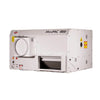
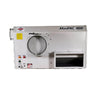
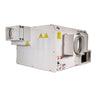
MP-1800 MiniPAC Desiccant Dehumidifier — 1800 CFM High-Volume Industrial Moisture Control Without Refrigerant Limitations
The Bry-Air MiniPAC MP-1800 is an 1,800 CFM desiccant dehumidifier rated at 54 lbs/hr moisture removal — the highest-output unit in the MiniPAC series before stepping into Bry-Air's full-size industrial line. It is built for large manufacturing floors, cold storage warehouses, pharmaceutical production suites, and food processing facilities where refrigerant equipment fails to maintain required humidity levels due to low ambient temperature, high moisture loads, or the need to drive relative humidity below 30% RH. The MP-1800 operates on 460/480V 3-phase power and weighs 532 lbs — a full industrial unit in a self-contained package suited to mechanical room installation.
MP-1800 Desiccant Rotor Capacity and Safety Systems
1,800 CFM process airflow at 1.7" wc external static — handles large open manufacturing floors, warehouse sections, refrigerated loading docks, and multi-room pharmaceutical suites requiring continuous high-volume dehumidification
54 lbs/hr moisture removal under standard conditions — consistent extraction rate at low temperatures where a refrigerant unit at equivalent CFM would be cycling through defrost or shut down entirely
600 CFM reactivation airflow at 0.5" wc — reactivation airstream removes adsorbed moisture from the desiccant rotor and exhausts it to the exterior; 600 CFM reactivation exhaust duct must terminate outside the building envelope
Desiccant rotor with stainless steel flange — water-washable media for on-site maintenance; stainless flange resists corrosion in high-humidity intake environments and during rotor washing
Insulated process and reactivation airflow chambers — thermally separated to prevent humid reactivation exhaust from contaminating conditioned process air output
460/480V / 3-phase / 60Hz power requirement — dedicated 3-phase electrical circuit required; facility electrician must verify panel capacity and circuit sizing before installation
532 lb unit weight — floor-mounting in a mechanical room or equipment pad is standard; structural load-bearing must be confirmed for suspended or elevated installations
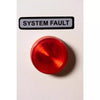
Differential air pressure switch — monitors process airflow and triggers alarm or controlled shutdown if filter blockage or fan fault reduces airflow below operating threshold
Safety thermostat on reactivation heater — protects heater elements from overtemperature during continuous 24/7 operation
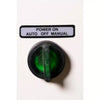
Reactivation cooldown sequence — heater elements cool before final shutdown to extend service life and prevent thermal shock
Optional weather kit, room humidistat, and duct humidistat add-ons — weather kit enables outdoor or semi-exposed installation; humidistat options enable setpoint-controlled auto cycling
MP-1800 Applications: Pharmaceutical, Food Processing, Cold Storage, and Power Generation
Pharmaceutical manufacturers specify the MP-1800 for large tablet coating lines, granulation rooms, and bulk powder packaging areas where moisture above 35% RH causes caking, coating failure, and active ingredient degradation at process scale. Food processing facilities — including candy production, soft gelatin capsule manufacturing, and onion drying operations — rely on it for the precise, continuous humidity control that refrigerant equipment cannot maintain when production temperatures drop near or below 50°F. Cold storage and refrigerated logistics operators install it at loading docks and staging areas where condensation on product, pallets, and rack structures is a daily operational problem that refrigerant dehumidifiers cannot resolve at low ambient temperatures. Power generation facilities use desiccant units to protect generators, turbines, and HRSG systems from corrosion during standby periods. Museums, archives, and library storage rooms specify the MP-1800 where a smaller MiniPAC unit is under-capacity for the space volume and collection moisture load.
Desiccant vs. Refrigerant at 1800 CFM: Scale Considerations for Industrial Deployments
At 1,800 CFM, the difference in operating behavior between desiccant and refrigerant technology becomes a direct operational cost question. A refrigerant unit at this CFM rating requires substantial compressor capacity — and that compressor produces zero moisture removal during defrost cycles. In a cold loading dock or freezer staging area cycling through defrost every 30–60 minutes, a significant fraction of total operating time produces no dehumidification. The MP-1800's desiccant rotor operates continuously with no defrost interruption, delivering the full 54 lbs/hr extraction rate across the temperature range of the application. The reactivation exhaust — 600 CFM of warm, humid air — must be ducted to the exterior; returning it to the conditioned space negates the dehumidification output. 460/480V 3-phase power is required; single-phase service is not compatible with this unit.
What makes the MP-1800 preferable to a refrigerant dehumidifier at 1,800 CFM for cold storage applications?
A refrigerant unit at 1,800 CFM requires a compressor-driven refrigerant circuit that loses capacity rapidly below 50°F ambient and stops effective moisture removal below 35°F. In a refrigerated loading dock or freezer staging area, this means periodic defrost cycles interrupting output and near-zero extraction at the lowest ambient temperatures — exactly when condensation is worst. The MP-1800 delivers its full 54 lbs/hr moisture removal at sub-freezing temperatures through a desiccant rotor with no compressor, no icing threshold, and no defrost cycle. The operational difference in cold environments is not marginal — it's the difference between a unit that works and one that cycles uselessly.
What duct sizing is required for the 600 CFM reactivation exhaust?
The 600 CFM reactivation exhaust requires a duct sized to handle that volume at low static pressure — typically an 18–20" round duct or equivalent rectangular duct at standard duct velocities. The reactivation external static is 0.5" wc, meaning the duct system must not impose more than 0.5" wc of resistance. Longer runs, elbows, and transitions add resistance — consult a mechanical engineer or refer to ASHRAE duct design tables to size the reactivation exhaust duct for your specific installation. The exhaust must terminate outside the building to prevent moisture recirculation.
Can the MP-1800 be used outdoors or in semi-exposed installations?
Not in standard configuration. The base MP-1800 is designed for indoor mechanical room installation. The optional weather kit is required for outdoor or semi-exposed installations — it provides enclosure protection against precipitation, wind-driven moisture, and temperature extremes that would damage the standard unit's electrical components. Contact Bry-Air or your distributor to confirm the weather kit specification and any installation restrictions for your specific climate.
How large a space can the MP-1800 serve, and how is that calculated?
At 1,800 CFM, the MP-1800 delivers 108,000 cubic feet of process air per hour. In a 10,000 sq ft warehouse with 16-foot ceilings (160,000 cu ft), that equates to approximately 0.675 air changes per hour — useful for moisture load management but not sufficient for rapid humidity drawdown. For tighter humidity targets or faster drawdown, multiple units or a larger Bry-Air industrial model may be appropriate. Bry-Air's engineering team can calculate required unit capacity based on your space volume, infiltration rate, internal moisture load, and target relative humidity.
What does the optional humidistat control, and when is it needed?
The optional humidistat — available as either a room humidistat or a duct humidistat — allows the MP-1800 to cycle on and off automatically when the conditioned space reaches its humidity setpoint, rather than running continuously. This is appropriate for spaces where the ambient moisture load is moderate and continuous operation would drive humidity below the target setpoint. In applications requiring continuous maximum extraction regardless of setpoint — pharmaceutical production lines in active operation, refrigerated dock areas with constant door cycling — manual continuous mode is more appropriate than setpoint cycling.
What is the MP-1800's weight and what does a 532-lb installation require?
The MP-1800 weighs 532 lbs. Installation requires a floor-mounted equipment pad or structural floor capable of supporting that static load, plus rigging or mechanical lift equipment to position the unit. Suspended or elevated installations require structural engineering review to confirm load-bearing capacity. The unit must be level for proper rotor operation and condensate drainage. Plan for forklift or pallet jack access to the installation location during initial setup and future maintenance.
How does the reactivation cooldown sequence protect the MP-1800 heater elements?
After a shutdown command, the MP-1800's reactivation cooldown sequence continues running the reactivation fan for a set period after cutting power to the heater elements. This allows the heater bank to cool down before airflow stops, preventing localized overtemperature on the heater elements and surrounding components. Shutting off airflow while heater elements are still hot would trap heat around the elements and adjacent materials, accelerating degradation. This sequence runs automatically on every normal shutdown — it is not operator-controlled.
Why Choose US Cleaning Tools?
See the price, buy now, get it fast. No quotes, no callbacks, no sales rep required.
No Quote Needed — All prices shown. Click buy, checkout, done.
Authorized Dealer — Brand-new units with full manufacturer warranty.
Trusted by 10,000+ Facilities — Schools, warehouses, contractors nationwide.
Fast Shipping — Trackable delivery in 2–8 business days.
Frequently Asked Questions
1. What payment methods can I use?
We accept Visa, MasterCard, American Express, Diners Club, Discover, major debit cards, and digital wallets like PayPal, Google Pay, Meta Pay, and Apple Pay.
2. When will my payment be processed?
Your credit/debit card or PayPal account will be charged when you place your order. Secure payment processing protects your information.
3. Will I receive an order confirmation?
Yes, a confirmation email will be sent to the provided email address once the order is placed.
4. How long does it take to process an order?
Orders are processed within 1-2 business days and then prepared for shipment.
5. How long does it take for my order to arrive?
Estimated arrival time (ETA) is 5-7 business days for all orders.
6. Do you offer warranty?
All our products come with a manufacturer warranty of at least 1 year, depending on the brand.
― Easy and convenient payment ―
― Verified security ―
✔ Secure payment ✔ 30-day return policy ✔ Data protection
Located in the Twin Cities in Minnesota, we acquired our Brio Air Filter in mid-late Spring of this year (2023) when pollen count was high and we were beginning to experience the effects of Poor Air Quality Index as a result of smoke particulates from fires in Canada that caused the air in much of Minnesota to become hazy and simply dirty.
It is so easy to share our experience with the Brio Air Filter given how quickly and efficiently it removed pollen, dust, and smoke particles from the environment inside our home. Two people in our home who suffer from pollen-related allergies during the spring immediately experienced easier breathing and elimination of symptoms within the house. With respect to smoke particulates from Canada drifting into our environment, EVERYONE in our home experienced directly improved breathing and smell of the air when entering from outside.
An additional piece of information to account for is that we have always employed high grade furnace filters in our home’s central HVAC system. With that high grade filtration in place both prior to and after acquiring a Brio home air filter, we all quickly agreed that deploying the Brio in our home made an easily noticeable positive difference in breathing inside our home. Additionally, those of us who clean our home have observed that dust builds up slower on our floors and furniture than before we deployed the Brio unit.
We did note that the Brio is not as quiet as a few other brands/models on the market that we have tried in our home but the efficiency and quality of the filtration, along with the air turnover rate it provides,allows us to locate the Brio unit in central rooms away from the bedrooms. Since we made that change there has been no noise-related effect on our sleep, while the unit maintains the same level of air cleanliness throughout our home.
A last key point to make is how easy the Brio unit is to maintain. The simplicity of the modular construction of the Brio unit makes it very quick and easy to keep the filtration sections clean. We have not yet reached a point of filter replacement but it is obvious to us that the replacement will take a matter of seconds and can be executed by anyone in our home, including our 10-year-old son.
It seems to help reduce my allergy issues. We're glad we bought it. The only problem I had was not seeing any cubic footage recommendations in the online description when purchasing the unit. Bedrooms vary widely in size!!